
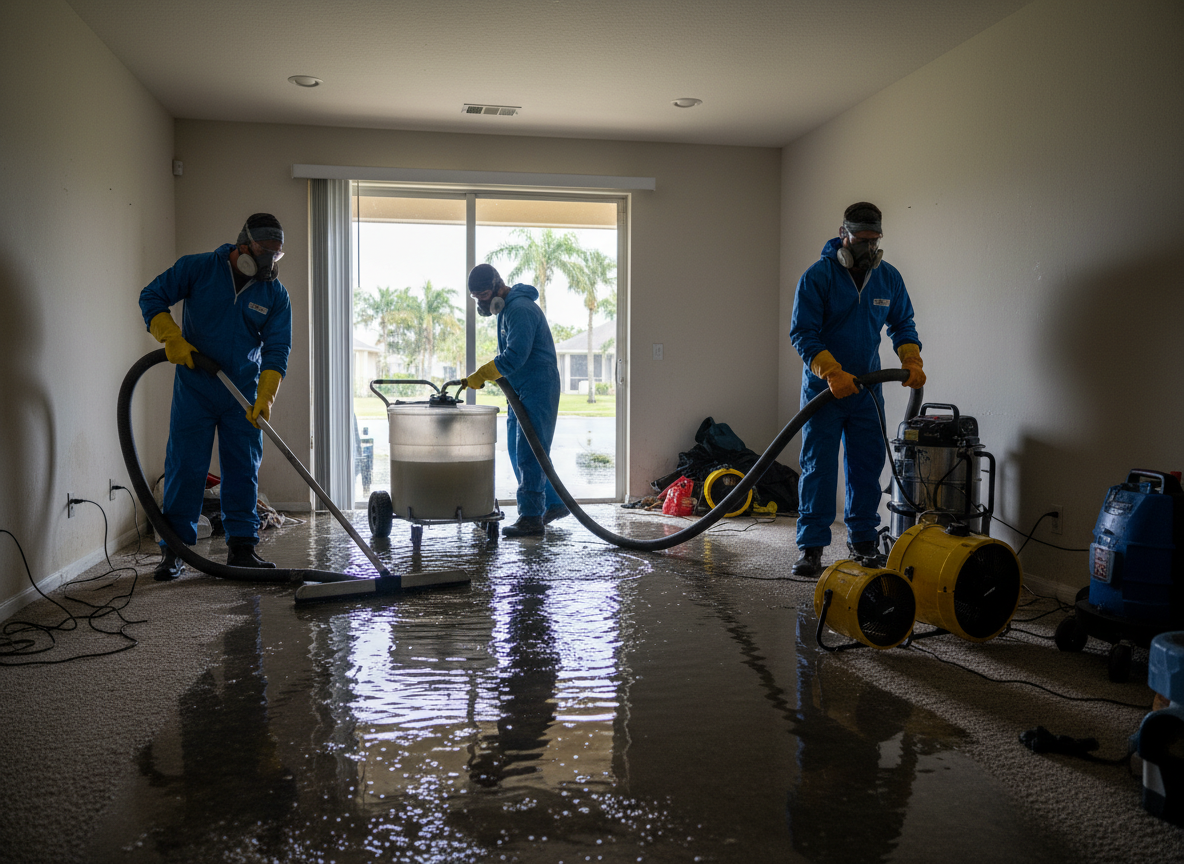
Water removal is the saturated-materials stage, not the puddle
Water removal Orlando begins after the standing water is gone: it is the work of taking water out of carpet, pad, subfloor, wall bases and the contents sitting in them. If water is still standing across the floor, that is extraction, not removal. The distinction matters because materials hold water long after a floor looks clear, and that is what feeds mold in Orlando's humidity.
What Orlando's humidity and flood history mean for your home
Orlando averages about 74 percent humidity and more than 53 inches of rain a year, so wet materials here can grow mold within 24 to 48 hours. Hurricane Ian in September 2022 dropped 12.49 inches of rain on Orlando in 24 hours and 8 to 14 inches across Orange County. See storm damage restoration in Orlando for the full storm and flood history.
What happens when an Orlando washing-machine hose bursts on an upper floor?
An upstairs washer flood sends water downward through ceilings and into lower rooms, so removal must address both levels, not just the laundry room.
This is a scenario national water removal Orlando competitors often rush past. A burst washing-machine supply hose on a second-floor laundry can release gallons per minute. Water races across the upper floor, soaks the carpet and pad, then finds the path of least resistance downward - through the ceiling below, into the room underneath, and along wall cavities to the first floor. In an Orlando slab home, water that reaches the lower level has few places to evaporate and spreads under baseboards and into adjoining rooms. If a crew only extracts the upstairs laundry room and leaves the wet ceiling and downstairs carpet, the hidden moisture remains. In Orlando's 74 percent average humidity, mold begins on damp drywall and subfloor within a day or two. Proper removal means extracting both floors, opening wet ceiling and wall cavities, and drying every affected assembly before closing up.
Removing saturated materials in Orlando's slab-era housing
Pine Hills and Azalea Park share a housing pattern that changes how removal is done: much of their stock went up between the 1950s and the 1970s, on slab-on-grade foundations with carpet, pad and baseboards over concrete. In those homes the pad is almost always removed. It holds water against the slab, cannot be dried reliably in place, and is cheap compared with the risk of a musty slab and a failed adhesive. The bottom plate, the baseboards and the lower section of drywall are treated as a boundary rather than a guess: if the plate reads wet against a dry reference, it comes out; if only the paint is damp, it may stay and be dried. The slab itself stays. Concrete can be dried in place with air movement and dehumidification, and removing it is a structural decision, not a water-damage one. That is why two houses on the same Pine Hills street can need different removals even after the same storm. The decision is made with readings at the wall base, the slab and a dry reference, not by how the floor looks.
Sources: U.S. Census Bureau QuickFacts: Pine Hills (https://www.census.gov/quickfacts/fact/table/pinehillscdpflorida/POP010220); U.S. Census Bureau QuickFacts: Azalea Park (https://www.census.gov/quickfacts/fact/table/azaleaparkcdpflorida/POP010220); build era from the Pine Hills and Azalea Park area pages.
Why choose us for water removal in Orlando instead of a national chain?
Removal is the saturated-materials stage, and it fails quietly when only the surface is treated. We use pumps, wet vacuums and a weighted extraction tool to pull water out of carpet, pad, subfloor and the contents sitting in it, then check with pin and pinless meters to see what is still wet. A national chain tends to treat removal as a short stop before drying and moves on once the floor looks clear. We stay with the materials long enough to separate what can be saved from what has to be replaced, and we tell you which is which before anything is discarded.
Why schedule water removal in Orlando the same day you discover flooding?
Because bulk water wicks into building materials within hours, and Orlando's humidity turns wet materials into mold risk within 24 to 48 hours.
Sources
- City of Orlando: floodplain information: https://www.orlando.gov/Our-Government/Departments-Offices/Public-Works/Engineering/Floodplain-Information
- PlantMaps: Orlando climate data: https://www.plantmaps.com/en/clim/f/us/florida/orlando/climate-data
- FEMA flood zone maps, City of Orlando: https://www.orlando.gov/Our-Government/Records-and-Documents/Map-Library/FEMA-Flood-Zone-Maps
- Orange County: storm repair and permit information: https://www.orangecountyfl.net/PermitsLicenses/StormRepairandPermitInformation.aspx
Water Removal Services We Offer
✓Garage and Utility Room Water Removal
Clearing water from garages, laundry rooms and utility areas after appliance failures.
✓Carpet and Rug Water Removal
Removing water held in carpet and rugs before it reaches the subfloor.
✓Slab and Tile Water Removal
Extracting water from slab surfaces and tile seams so it does not wick into adjacent rooms.
✓Stormwater Removal
Removing rain-driven water after Central Florida storms and heavy summer downpours.
✓Contents and Furniture Water Removal
Lifting and drying furniture, rugs and stored contents that have taken on water, with each item photographed before it is moved.
How it works
- 1
Emergency call and dispatch
Call (407) 469-7018 and we dispatch from 4701 Millenia Blvd, Suite 175 to start water removal the same day where possible.
- 2
Water source and spread check
We confirm the source has stopped and trace how far the water has traveled.
- 3
Bulk water removal
Pumps and wet-extraction units remove standing water from floors, subfloors and low spots.
- 4
Moisture check after removal
We measure remaining moisture so we know whether drying equipment is needed next.
- 5
Documentation
We record affected areas and readings for your homeowner and insurance records.